Oral arguments granted in Carly Gregg appeal

By Anthony Warren Published: Apr. 2, 2026 at 5:14 PM BST

JACKSON, Miss. (WLBT) - Attorneys for a Rankin County teen who was sentenced to life in prison after killing her mom and shooting her stepdad will get to argue their case before the Mississippi Supreme Court in person.

The high court recently granted attorneys’ request for oral arguments in Carly Gregg’s appeal, more than a year and a half after she was convicted of first-degree murder and other charges in Rankin County Circuit Court.

Arguments are set for Wednesday, May 27, at 10:30 a.m.

The former Northwest Rankin High School student shot and killed her mother, Ashley Smylie, a teacher at Northwest, and shot her stepfather, Heath Smylie, before fleeing her home in 2024.

Gregg was also sentenced to life in prison for the attempted murder of Heath Smylie, and 10 years for tampering with evidence.

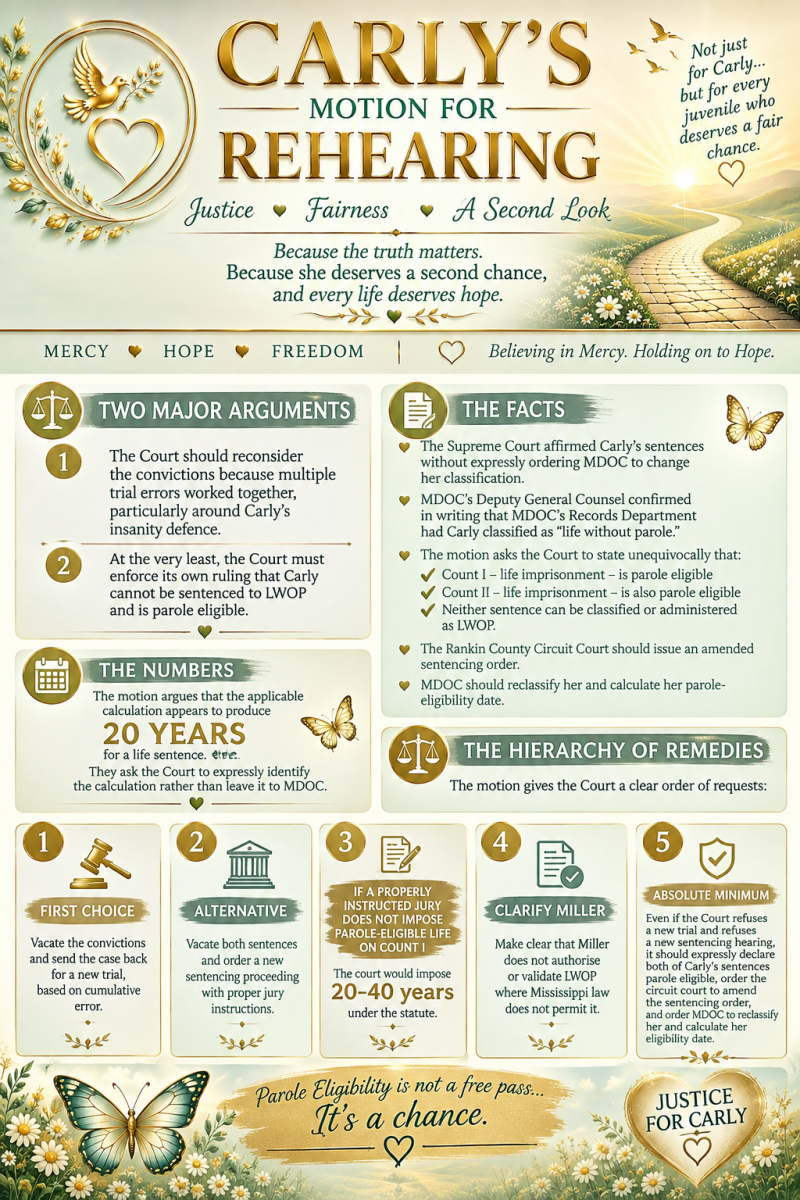
Attorneys for Gregg appealed that sentence, arguing in part that the trial court erred by giving jury instructions that were improper under Mississippi state code, and that the life sentence on the attempted murder charge was “categorically unconstitutional.”

According to court records, the prosecutor in the case made “improper and highly prejudicial comments during closing arguments related to parole eligibility.”

The prosecutor allegedly said during the sentencing phase that if Gregg was given parole, “no one in this room knows how long she will stay there” and that “we cannot guarantee that she will stay there one year or 10 years. We have no control over that.”

"Mississippi has consistently disapproved of argument which discusses potential punishment of a defendant,” the appeal states. “Although [i]t is well established in Mississippi that attorneys are given wide latitude in arguing their cases to the jury, tactics which are inflammatory, highly prejudicial and reasonably calculated to unduly influence the jury are not permissible.”

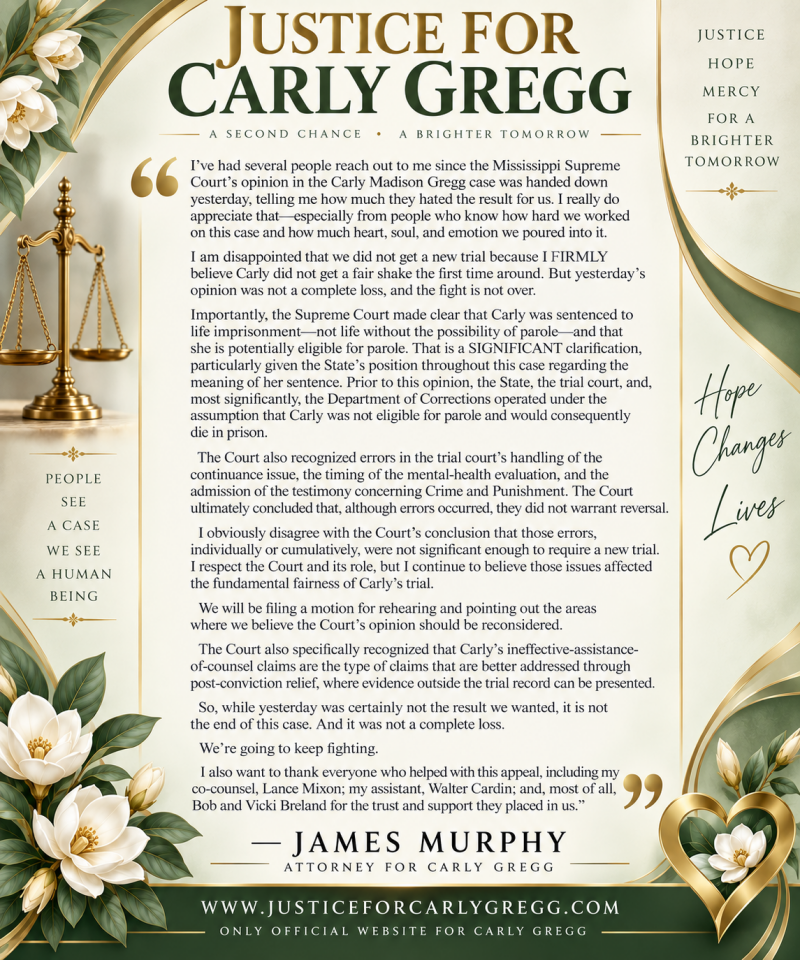
The court’s decision granting oral arguments comes months after a group known as “Carly’s Warriors” began a letter-writing campaign asking for mercy for the teen.

About 10 letters have been sent to the court on Gregg’s behalf, which were submitted by Piotr Swiatkowski on February 20. It was filed on March 6.

In the letter, the Dublin, Ireland resident urged the court to reduce Gregg’s sentence, saying that the teen was only 14 at the time of the offenses, and that the defendant was likely suffering from mental health challenges.

“International norms increasingly recognize that children should have meaningful opportunities for rehabilitation, reinforcing the principle that youth diminishes culpability and allows for growth,” he wrote. “I respectfully urge the court to reconsider whether a life-without-parole sentence imposed on a 14-year-old aligns with constitutional protections.”


On the day of Oral Arguments 

Oral arguments are not a new trial, and no witnesses are called. This is a formal hearing before appellate judges, where Carly’s attorneys and the State’s attorneys present their legal arguments directly to the court.

The judges enter. The case is called. Everyone stands. The courtroom becomes quiet, formal, and structured. The weight of what is at stake can be felt by everyone present.

Carly’s legal team argues first.

Her attorneys explain why they believe errors were made, why her sentence should be reconsidered, or why relief should be granted. They speak about constitutional principles, youth sentencing standards, mitigation, rehabilitation, and the belief that a child’s life should not be permanently defined by one tragic chapter.

Then come the questions.

The judges may interrupt with difficult and direct questions. This is one of the most important parts of oral arguments. Tough questioning does not automatically mean things are going badly. Often, it means the judges are deeply engaged with the issues before them.

Then the State responds.

Prosecutors argue why they believe the conviction or sentence should remain in place.

After that, Carly’s attorneys are usually given rebuttal time, a final opportunity to answer the State’s arguments and reinforce the strongest points of Carly’s case.

When oral arguments end, there is usually no decision that same day.

The judges return to review everything again. They discuss the case privately and begin working toward a written opinion. That process can take weeks, sometimes months.

For families and supporters, oral arguments are emotionally enormous because this is often the first time appellate judges directly engage face to face with the human and constitutional issues at the center of the case.

Years of pain, hope, fear, and waiting can feel as though they come down to a single morning in court. And for many supporters, the hardest part begins afterward, the waiting. Once arguments are over, everything rests in the judges’ hands while everyone waits for the written decision.

In cases involving someone so young, these arguments are not only about law. They are also about youth, maturity, rehabilitation, mercy, and whether a child’s future should be permanently defined by the worst moment of their life.After oral arguments, outcomes can vary quite a bit in timing. There is usually no immediate ruling from the bench the same day. For a case of this magnitude and public interest, a written decision could realistically take a few weeks at the very fastest, but more commonly several months.


During the waiting period

The judges typically review the oral arguments again, study the trial record, discuss the legal issues privately, draft opinions, and sometimes write concurring or dissenting opinions if they disagree with one another.

Complex juvenile sentencing and constitutional cases often take longer because the court is weighing not only technical legal issues, but broader questions about youth, rehabilitation, and sentencing standards.

The court usually gives no updates, supporters often hear nothing publicly, and the written opinion simply appears once finalized.

Emotionally, many families say the period after oral arguments can feel even harder than the lead-up, because everything is now entirely in the judges’ hands.


Decision

In Mississippi appellate cases, the written opinion is typically filed officially with the court, whilst sent electronically to the defense and prosecution attorneys.

Published publicly online through the court system shortly afterward, sometimes immediately.

In high-profile cases, supporters and media often learn about the decision very quickly because: attorneys may issue statements, reporters monitor the court docket, and the opinion becomes publicly accessible online once released.

The written opinion itself can be very detailed, sometimes dozens of pages long, explaining, what the judges decided, why they decided it, which legal arguments succeeded or failed,and whether any judges agreed or dissented separately.

So on decision day, Carly’s legal team would likely know first or at the same time the opinion becomes public. 


Outcome

The court may uphold the original ruling.

It may order resentencing.

It may send the case back to a lower court.

It may grant relief on certain legal issues.

Or it may issue another form of ruling entirely.


💜 March 19 2026 💜

730 days.

730 days. Not a single day goes by that Carly wouldn’t change things if she could. She was 14. She was in a mental health crisis. And the family has been living in the aftermath ever since.

They grieve Ashley every day, they honor her and carry her memory, whilst at the same time fighting to save the little girl who took her life.

This was a family mental health crisis in Mississippi,  the kind no one thinks will ever happen to them.

Families need help. Children in crisis need treatment, not permanent condemnation.

In 2026, the Mississippi Supreme Court will hear Carly’s appeal.  We pray they see a child who was struggling and who is capable of growth, healing, and redemption.

We can grieve Ashley deeply, while still believing Carly’s life is worth saving.

Please hold the whole family in your prayers on March 19th 2026.