
Understanding the potential risks of treatments for children's mental health.
SSRI and Violent Crime — What Does the Research Show?
A large observational study involving 856,493 individuals prescribed selective serotonin reuptake inhibitors (SSRIs) examined whether periods of SSRI treatment were associated with violent crime convictions.
The researchers reported an association in certain age groups, particularly younger individuals. However, the findings did not establish that SSRIs directly caused violent behaviour.
Mental health conditions, individual circumstances and other factors may influence these associations. The study highlights the importance of further research and careful monitoring, particularly when antidepressants are prescribed to young people.
SSRIs can provide important benefits for some children and adolescents. Their potential risks and benefits should be assessed individually, with appropriate medical supervision.
Read more:
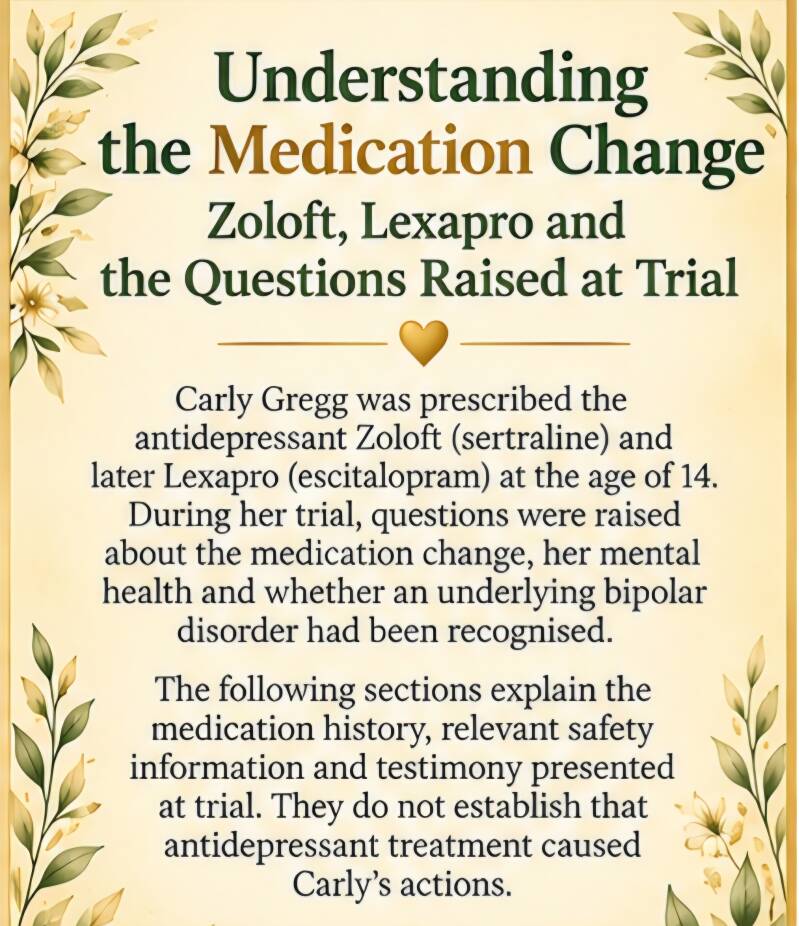
DR ANDREW CLARK'S TESTIMONY
At trial, Dr Andrew Clark, a psychiatrist board-certified in adult, child and adolescent, and forensic psychiatry, testified that he diagnosed Carly with bipolar II disorder.
Before the tragedy, Carly had received medication management from a psychiatric mental health nurse practitioner and counselling from a licensed professional counselor she did not see a psychiatrist.
Dr Clark raised concerns that antidepressant treatment could worsen bipolar symptoms.
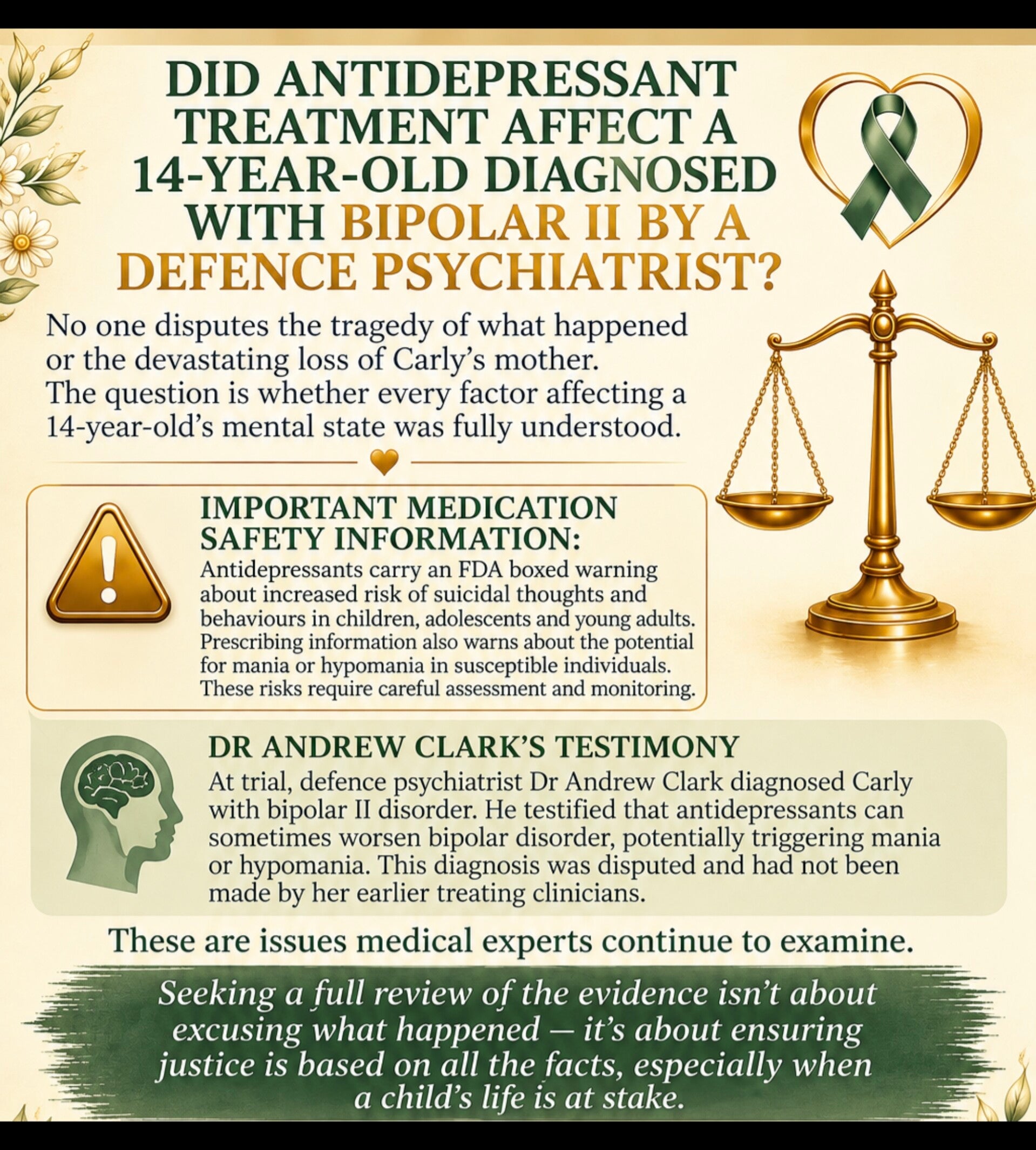
Zoloft to Lexapro — Carly Gregg's Medication History and Trial Evidence
Carly was prescribed the antidepressant Zoloft (sertraline) and later Lexapro (escitalopram) at the age of 14. During her trial, questions were raised about the medication change, her mental health and whether an underlying bipolar disorder had been recognised. The following sections explain the medication history, relevant safety information and testimony presented at trial.
What Happened
Carly was prescribed Zoloft (sertraline) by a psychiatric mental health nurse practitioner.
She was subsequently prescribed Lexapro (escitalopram), with instructions to transition gradually between the two medications.
At trial, defence psychiatrist Dr Andrew Clark testified that Carly instead stopped Zoloft abruptly and began taking Lexapro.
This distinction between the prescribed transition and Dr Clark's account of what occurred is important when reviewing the medication evidence.rial, defence psychiatrist Dr Andrew Clark, a specialist in adult, child and adolescent, and forensic psychiatry, testified that he diagnosed Carly with bipolar II disorder. He raised concerns about the potential effects of antidepressant treatment in someone with bipolar disorder.
Before the tragedy, Carly had received medication management from a psychiatric mental health nurse practitioner and counselling from a licensed professional counselor. Dr Clark's diagnosis and interpretation of Carly's mental state were disputed by prosecution experts.
These differences in clinical opinion highlight the importance of examining the complete medical evidence without assuming that any single diagnosis or medication explains what happened.


What Is an Antidepressant-Induced Manic Switch?
An antidepressant-induced manic switch occurs when antidepressant treatment is associated with the emergence of mania or hypomania. This is a recognised clinical concern, particularly in individuals with bipolar disorder.
Possible symptoms of mania or hypomania include unusually elevated or irritable mood, increased energy, reduced need for sleep, racing thoughts, impulsivity and significant changes in behaviour.
Severe manic episodes can sometimes involve psychotic symptoms, although psychosis is not a defining feature of hypomania.
FDA Medication Safety Information
Antidepressants carry an FDA boxed warning about an increased risk of suicidal thoughts and behaviours in children, adolescents and young adults. This warning does not establish that antidepressants cause homicidal behaviour.
Prescribing information for SSRIs also advises clinicians to assess patients for bipolar disorder and warns that antidepressant treatment may precipitate mania or hypomania in susceptible individuals.
These concerns underline the importance of appropriate assessment, careful prescribing and monitoring for changes in mood or behaviour.


Why the Medication Change Warrants Review
The transition from Zoloft to Lexapro raises questions that merit careful examination of the clinical records and trial testimony.
These include the reasons for changing medication, whether bipolar disorder was considered before treatment, the instructions given for the transition, whether those instructions were followed, and any changes in Carly's mental state during that period.
A thorough review should distinguish documented medical facts from competing expert interpretations and consider the evidence presented by both the defence and prosecution.
Why This Matters — Dr Andrew Clark's Testimony
Carly was 14 years old when these events occurred.
At trial, defence psychiatrist Dr Andrew Clark, a specialist in adult, child and adolescent, and forensic psychiatry, testified that he diagnosed Carly with bipolar II disorder. He raised concerns about the potential effects of antidepressant treatment in someone with bipolar disorder.
Before the tragedy, Carly had received medication management from a psychiatric mental health nurse practitioner and counselling from a licensed professional counselor. Dr Clark's diagnosis and interpretation of Carly's mental state were disputed by prosecution experts.
These differences in clinical opinion highlight the importance of examining the complete medical evidence without assuming that any single diagnosis or medication explains what happened.

SSRIs and Violent Crime — The Molero and Fazel Study
Professor Seena Fazel and colleagues at the University of Oxford examined the relationship between selective serotonin reuptake inhibitor (SSRI) treatment and violent crime convictions in a large Swedish population study involving 856,493 individuals prescribed SSRIs.
The researchers compared periods when the same individuals were receiving SSRI treatment with periods when they were not. This approach helped account for certain individual differences, although other factors could still have influenced the results.
The study reported an association between SSRI treatment and violent crime convictions among individuals aged 15–24. It did not establish that SSRIs caused violent behaviour, and its age-specific findings cannot be directly applied to Carly, who was 14 at the time of the tragedy.
Original Scientific Research — Molero, Fazel and Colleagues
The original peer-reviewed study, published in PLOS Medicine in 2015, is reproduced below so readers can examine the researchers' methods, findings and limitations directly.
The study identified an association between SSRI treatment and violent crime convictions among individuals aged 15–24.
The study attracted international media attention, with reports published by the Los Angeles Times, The Telegraph and The Huffington Post.
Some headlines emphasised the increased association between antidepressant treatment and violent crime convictions among younger individuals. However, newspaper headlines should be distinguished from the scientific findings themselves.
The research identified an association, not proof of causation. It remains important to consider the study's limitations, the possible benefits of SSRIs and the individual circumstances of patients receiving treatment.