The death of Ashley Nicole Smylie was a devastating tragedy. Nothing on this website is intended to minimise her loss, the suffering of her loved ones, or the seriousness of what happened.
But acknowledging that tragedy does not mean we should stop asking questions about how a 14-year-old child was tried, sentenced and treated by the justice system.
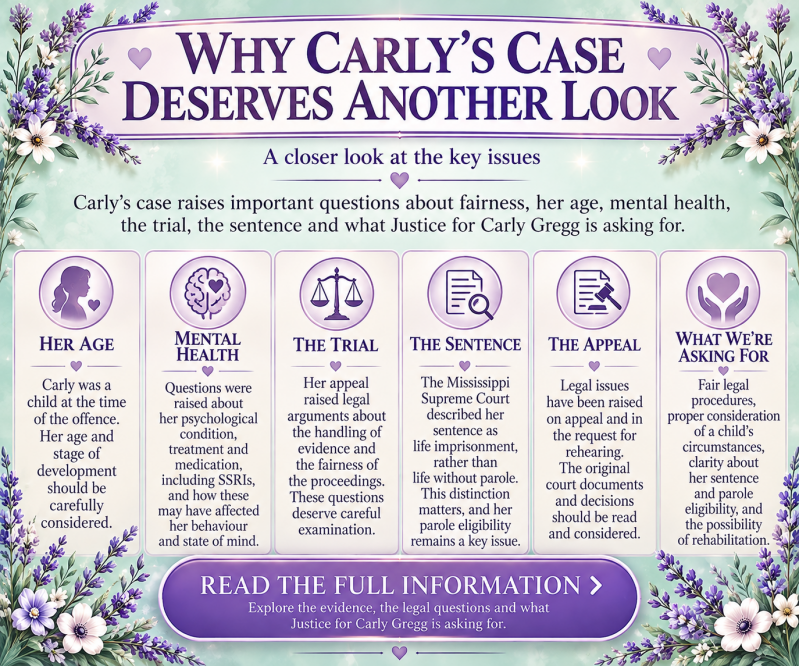
Justice for Carly Gregg believes that Carly's age, mental health, the circumstances surrounding her trial and the legal issues raised on appeal deserve careful consideration.
We are not asking visitors to ignore what happened or agree with every concern we raise. We are asking them to look beyond the headlines, examine the available evidence and consider whether every aspect of this case has received the scrutiny it deserves.
Why Carly's Age Matters
Carly Gregg was just 14 years old when the events of March 2024 took place. Her age does not diminish the seriousness of what happened or the devastating loss of Ashley Nicole Smylie.
However, childhood and adolescence are important considerations in the justice system. Young people are still developing their ability to regulate emotions, assess consequences and make decisions under pressure.
The United States Supreme Court has recognised that children are constitutionally different from adults for sentencing purposes because of their developmental characteristics and greater potential for change.
This raises an important question: was Carly's age, individual development and capacity for rehabilitation given sufficient consideration throughout the legal proceedings and sentencing?
Accountability and the possibility of rehabilitation should not be treated as opposing principles. Both deserve careful consideration when a child faces a sentence that could affect the rest of their life.
Mental Health and the Questions Raised at Trial
Carly Gregg's mental health became an important issue in the legal proceedings following the tragic events of March 2024.
Questions were raised about her psychological condition, her treatment and medication, and how these factors may have affected her behaviour and state of mind.
Mental health difficulties do not automatically remove criminal responsibility. Equally, when a child faces extremely serious charges, evidence concerning their mental health deserves careful examination.
The important questions are what the evidence showed, how it was presented and challenged at trial, and whether the legal process gave these issues appropriate consideration.
Justice for Carly Gregg believes visitors should have the opportunity to examine the relevant court documents and legal arguments for themselves, rather than relying solely on headlines or short clips from news coverage.
Questions About the Trial and Sentencing
Carly Gregg was convicted in September 2024 of murder, attempted murder and evidence tampering. These convictions concern extremely serious acts, and nothing in this campaign seeks to diminish the harm caused or the loss of Ashley Nicole Smylie.
However, a conviction does not mean that questions about the fairness of the proceedings, the handling of evidence or the appropriateness of a sentence should go unexamined.
Carly's appeal raised legal arguments concerning aspects of her trial and sentencing. These arguments must be distinguished from findings made by the courts, and visitors are encouraged to read the original filings and decisions rather than rely solely on summaries.
On 20 August 2026, the Mississippi Supreme Court issued an opinion describing Carly's sentence for murder as life imprisonment, rather than life without parole. This distinction matters, but it does not by itself resolve the separate question of her eligibility for parole.
A request for rehearing was subsequently filed, seeking further consideration of issues raised in the case.
Justice for Carly Gregg believes that accountability, fair legal procedures and the careful consideration of a child's circumstances can and should exist together.
What Justice for Carly Gregg Is Asking For
Justice for Carly Gregg is not asking anyone to forget Ashley Nicole Smylie, minimise the tragedy of her death or suggest that serious actions should have no consequences.
We are asking for Carly's case to receive fair, thorough and careful consideration, including the legal concerns raised about her trial, her mental health, her age at the time of the offence and the sentence imposed.
We believe that a child should be held accountable through a justice system that also recognises the importance of development, appropriate treatment and the possibility of rehabilitation.
Our campaign supports proper consideration of the legal issues raised on appeal and in the request for rehearing. We also seek clarity about Carly's sentence and parole eligibility.
We do not expect every visitor to agree with us. We simply ask that you examine the court documents, consider the questions raised and remember that fairness and accountability are not mutually exclusive.
Justice should be informed by evidence, guided by fairness and open to the possibility of change.